

An industrial equipment distributor came to me with a website that nobody outside their existing customer base could really find or remember. Solid product line, established reputation on the ground, built over years of relationships and repeat business. None of that showed up online.
I see this pattern with distributors more than most. The website looks fine on the surface, a product page here, a contact form there, but it gives a visitor almost nothing to hold onto and no sense of who to talk to about it.
The problem: invisible online, disconnected from real leads
The site wasn’t building brand recognition, and it wasn’t helping leads reach anyone once they landed there. A visitor could browse a few pages, maybe find a generic contact form, and then wait. There was no clear path from interest to a real conversation with someone who could actually answer a question.
For a distributor competing for RFQs and quote requests, that gap matters more than it looks. A lead who cannot quickly reach a knowledgeable person moves on to whichever supplier makes that easier.
The reframe: the website needed a live sales team, not just a presence
The insight that shaped the rebuild was simple to state and easy to miss in practice. A qualified, knowledgeable sales team reachable through the website during office hours does more for a lead than a page that simply exists online, the same way a visitor to the physical office would be greeted by someone who could help.
Once I framed the project around that team rather than around pages and layout, the priorities became clear. Every part of the site needed to move a visitor closer to a real conversation, as directly as possible.

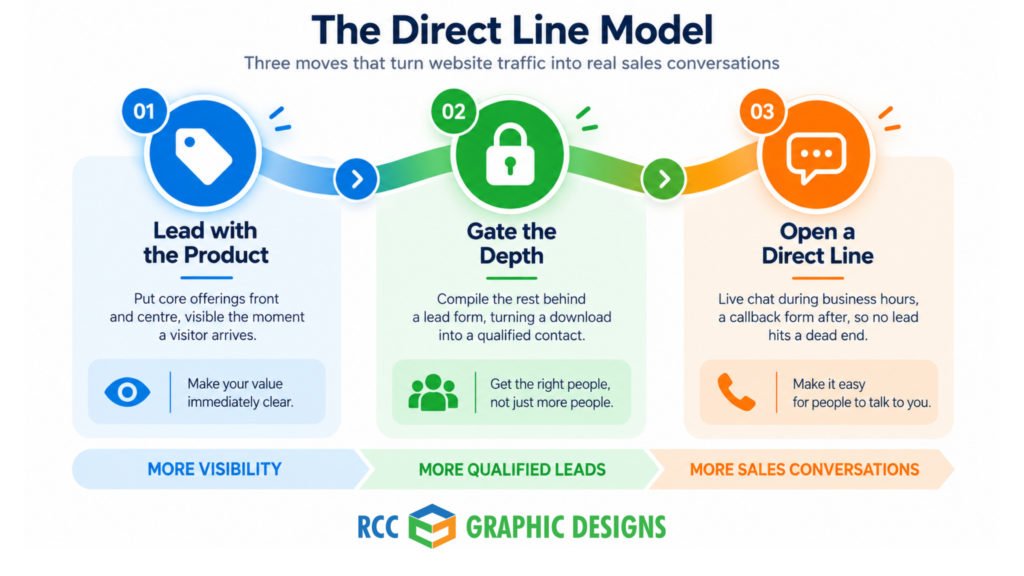
The Direct Line Model
I built this project around three moves, each one shortening the distance between a visitor and a real answer. The first two get the right information in front of the right visitor. The third makes sure that information leads somewhere.
Lead with the product
The homepage puts the core product offerings front and centre, immediately visible on arrival instead of buried behind an About page or a slideshow.
Gate the depth
Information on the business’s other offerings, previously never compiled anywhere a visitor could easily find it, becomes available through a downloadable resource captured behind a lead form. That extra step costs a visitor a few seconds, but it turns a quiet file download into a qualified contact the sales team can follow up on directly. That’s a fair trade when a distributor is competing on responsiveness as much as on content.
Open a direct line
A live chat channel during business hours connects a visitor directly to the sales team, an extra layer added on top of the core rebuild. Outside those hours, the chat window switches to a short fallback form that captures contact details for a callback the next business day, so the door never fully closes.
Execution
The rebuild put the core product line at the top of the homepage, exactly as the business had asked for. Information on their other offerings had never been readily available before, so I compiled it into a downloadable PDF catalogue and released it through a lead capture form, turning every download into a qualified contact instead of a quiet file transfer.
As a value-added feature on top of that request, I introduced a live chat window running during business hours, routed directly to the sales team’s desktops and phones. A visitor with a question reaches a real person in real time, instead of waiting on a delayed reply to a form submission. After hours, that same chat window hands off to a fallback form, so evening and weekend visitors still leave their information instead of hitting a dead end.
What changed
Leads are now coming in through three channels that did not meaningfully exist before: the live chat, the catalogue download form, and the general inquiry form. Over the first three months, that settled into a steady 10 to 20 qualified call leads a month, a pace that has held in the months since. The sales team is fielding real, qualified questions as they happen instead of chasing static form submissions after the fact, and leads that reach a live conversation are moving through the sales stage within the week rather than sitting in a queue.
That shift has cut down the time spent returning calls and re-explaining information a lead already needed at the moment of first contact. It moves the buying decision forward faster on both sides.
The client summed up the experience this way: “Their team is highly professional and knowledgeable. Rommel took the time to listen to our ideas and worked closely with us to create a website we’re all very proud of. We look forward to continuing to grow our online presence together.”
Strategic takeaway
A distributor website gets more done by getting a visitor to a real conversation as fast as possible, with enough information along the way to make that conversation worth having, rather than trying to do everything at once. For this client, that meant leading with the product, gating previously unavailable information behind a simple lead capture, and adding a live sales team one click away, with a fallback in place for the hours nobody is watching the chat.
If your website is generating traffic without generating real conversations, I offer a free audit call to look at where that connection is breaking down.


